
— COMPLIANCE & AUTHORISATION —
IDs and approvals — linked to the individual, stored securely in the vault.
From identity cards and firearms licences to species-protection certificates: auction manager keeps every mandatory document exactly where it belongs — verified, monitored for expiry and stored in encrypted form. No email inbox, no network drive, no unprotected data gaps.
◆ GwG
◆ Object- and value-dependent
◆ Weapons Act
◆ CITES / Species protection
◆ Cultural property protection
◆ GDPR
— THE STATUS QUO —
Supporting documents are your greatest liability risk — and they are stored in email inboxes.
Auction houses have long been checking identities and authorisations. The problem is that conventional systems do not retain proper evidence of these checks. As a result, copies of IDs and permits are often stored in three places at once — none of them securely.
01
Scattered
ID copies in emails, permits on network drives, deadlines in Excel. How can you tell which document is currently missing for which customer?
02
Unprotected
Highly sensitive personal data stored in plain text. A lost laptop or an open folder can be enough to trigger a reportable data-protection incident.
03
Disconnected
The cashier does not know whether a bidder is actually authorised to purchase the handgun. Approvals are given verbally rather than on the basis of documented evidence.
— COMPLIANCE LINKED TO THE INDIVIDUAL —
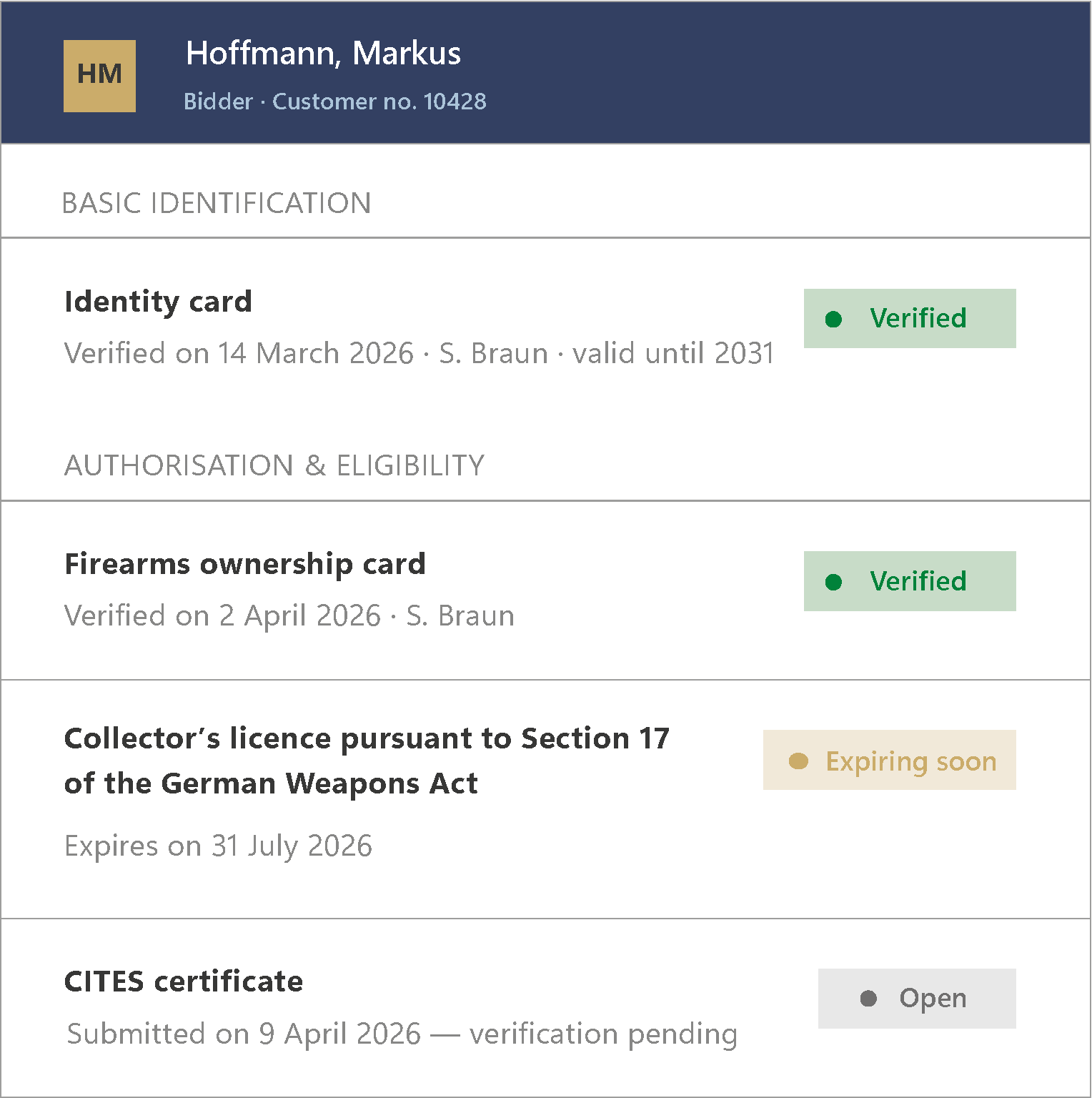
Every document is linked to the individual — with status, expiry date and verification record.
Guided verification workflow
Every document passes through the statuses open → verified → rejected. The reviewer and verification date are recorded, and the reason for rejection is documented.
Automatic expiry monitoring
IDs and permits expire. The system knows the validity period for each document type and issues a warning before a document becomes invalid.
Fully documented instead of managed through notes and spreadsheets
Who checked what, and when? Every change is recorded with the user and timestamp — creating the traceable audit record expected under the AML Act and by supervisory authorities.
One place instead of three
Identity and authorisation information in one view linked to the individual — not distributed across emails, folders and spreadsheets.
— THE VAULT —
IDs are stored in encrypted form — not simply filed away.
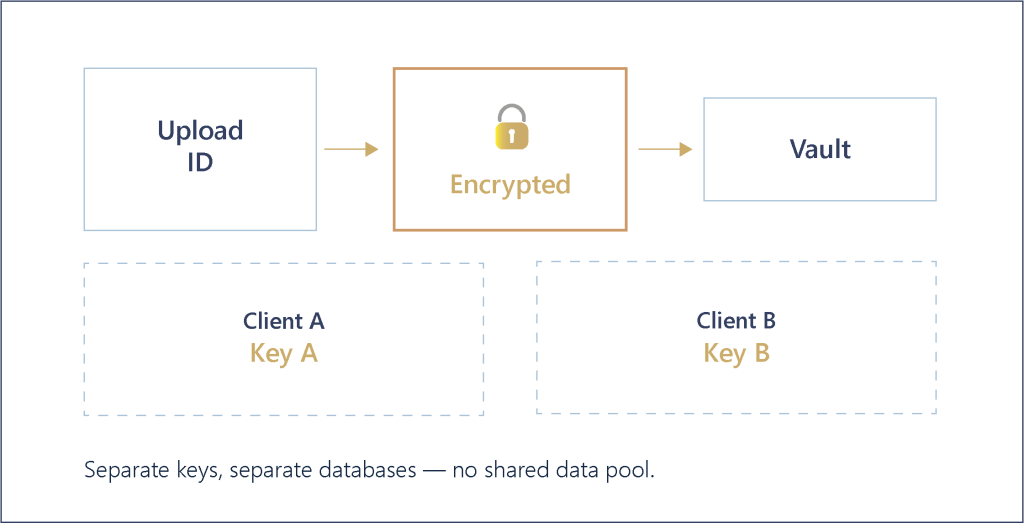
This is where auction manager differs from other auction software: sensitive documents are never stored in plain text on a drive.
Encrypted during upload
Every ID file is encrypted as it is uploaded. Only ciphertext is stored on the data carrier — nothing readable.
A separate key for each client
Every client has its own encryption key, stored in its own database. This cryptographically prevents access across client boundaries — rather than relying solely on permissions.
Plain text only at the moment of retrieval
The document is decrypted only when it is opened by an authorised user — temporarily and never stored permanently in readable form.
Key rotation at the touch of a button
The key can be renewed periodically without modifying the underlying business data. Security that remains maintainable during operation.
— DOCUMENT TYPES—
From basic identification to firearms-law approval.
Two categories cover the entire field. Identity verification is included by default, while profession- and item-specific documents can be configured precisely for your range of goods.
Basic identification
Every customer, every auction
PRECONFIGURED
- Identity card
- Passport
Authorisation & eligibility
Weapons, art, protected goods
FREELY CONFIGURABLE
- Firearms ownership card
- Collector’s licence pursuant to Section 17 of the German Weapons Act
- Certificate of expertise pursuant to Section 7 of the German Weapons Act
- CITES / species-protection certificate
- End-user declaration
- Cultural-property export permit
Each document type has its own validity period, mandatory-document setting and expiry warning. You define which documents your auction house requires — the examples in the second column are typical templates, not a fixed list.
— RULE ENGINE —
A rule decides which document is mandatory for which lot — not a phone call.
Compliance does not apply universally, but selectively depending on the item. Many requirements depend solely on the type of object and are completely independent of price: a weapon requires a firearms ownership card, while protected materials require a CITES certificate. Other requirements depend on the value — for a winning bid above €10,000, a valid ID is mandatory under the AML Act. This is only one of many possible requirements. You define the appropriate rule for each product group or object; the system checks it and either grants approval or blocks the transaction.
Step 01
Define the requirement
For each product group or object, specify which document is mandatory.
Handguns → firearms ownership card required
Ivory → CITES required
Lot above €10,000 → ID required under the AML Act
Step 02
Check the status automatically
The system compares the requirement in real time with the individual’s verified and valid document status.
Step 03
Grant approval
The bid and winning bid are approved only when the requirement has been fulfilled. If the document is missing, the system blocks the transaction — and records the reason.
— THE DIFFERENCE —
What conventional auction software does not provide.
Other solutions treat ID documents, at best, as file attachments. With auction manager, legally compliant authorisation is part of the core process.
CONVENTIONAL AUCTION SOFTWARE
- ID storage - Loose file attachment stored in plain text
- Documents - Manual Excel list without deadlines
- Weapons and species-protection law - Not represented
- Bid approval - Granted verbally
- Client separation - Based only on permissions

- ID storage - Encrypted vault linked to the individual
- Documents - Categorised, with status and expiry warning
- Weapons and species-protection law - Dedicated document types and rules for each product group
- Bid approval - Rule-based, including the AML threshold
- Client separation - Cryptographic separation with an individual key
Turn compliance from a risk into a sales argument.
In a live demo, we will show you how identity verification, encrypted storage and bid approval work together in one continuous process — using your product groups as an example.